


Since its creation three years ago by the IRA, the federal Inflation Reduction Act of 2022 (P.L. 117-169), we’ve been reporting on the Medicare Drug Price Negotiation Program being administered by CMS (Centers for Medicare & Medicaid Services). In a nutshell, this Program empowers CMS to negotiate with pharmaceutical companies over the maximum fair price (MFP) for selected drugs.
Also, as we reported in our July Voice, an executive order, issued in May, sought to implement a “most favored nation” (MFN) drug pricing policy. Conceptually, MFN would reduce U.S. drug prices to those in other countries. It required that U.S. Health and Human Services Secretary Robert F. Kennedy Jr. set clear targets for price reductions across all U.S. markets within 30 days. As we went to press, these targets have not been set.
If “adequate progress” is not made toward those targets, then HHS Secretary Kennedy will impose the most favored nation pricing on the drugs through rulemaking.
While the pharmaceutical companies have sought on several fronts to eliminate the Program, their efforts have not been successful, and CMS has been pushing forward with four cycles of negotiations.
Here’s the latest in connection with the first two cycles.
1st Cycle of Selected Rx Drugs New Prices Effective January 1
Over one year ago (October 2024 Voice), we reported on the MFPs for the ten drugs that were negotiated during the 1st cycle and that these prices would take effect on January 1, 2026. We’re now on the doorstep of that effective date.
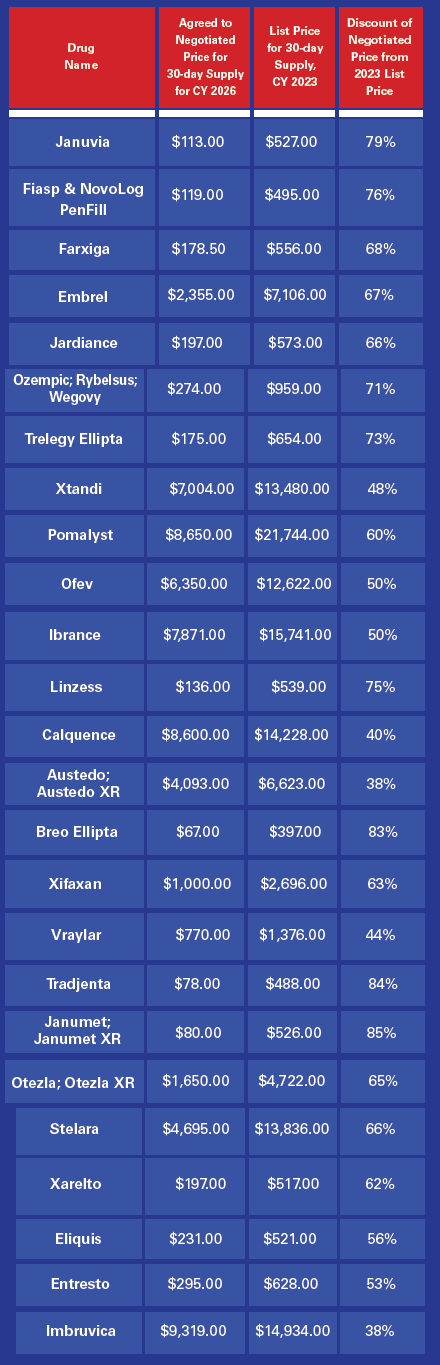
As shown in the chart below, the projected savings range from 79% to 38%. According to CMS, it’s expected that savings from the new MFPs for those drugs will generate about $6 billion for taxpayers and $1.5 billion for Medicare enrollees.
2nd Cycle of Selected Rx Drugs New Prices Announced
Earlier this year, CMS issued the next list of 15 prescription drugs whose MFPs will be negotiated during the 2nd cycle and will take effect January 1, 2027. It’s noteworthy that three GLP-1 drugs, namely Wegovy, Ozempic and Rybelsus, are included in this cycle. For more news on GLP-1s, see page 7.
While Ozempic and Rybelsus are manufactured by Novo Nordisk for diabetes and weight loss, Ely Lilly produces Wegovy for cardiovascular risk prevention and weight loss. It’s been reported that these three GLP-1 drugs collectively accounted for more than $14 billion in gross Medicare drug costs from November 2023 to November 2024.
This past November, the Trump Administration announced that it had separately reached voluntary agreements with Novo Nordisk and Lilly on reducing the prices of their GLP-1s and expanding Medicare coverage for weight loss. When we went to press, the precise timeline for the coverage expansion and the extent of who will gain access remained unclear.
We expect to report more on this in our next (April 2026) Voice.
Besides Wegovy and Ozempic, some of the other medications in the 2nd cycle include Trelegy Ellipta, which treats asthma; Otezla, a psoriatic arthritis drug; and several that treat different forms of cancer. It’s been estimated that the 25 drugs in both the 1st and 2nd cycles account for a whopping one-third of Medicare spending on prescription drugs.
Again, the agreed-upon MFPs for the 2nd cycle will take on January 1, 2027.