




Sharing Investment Success With Retirees Key Element
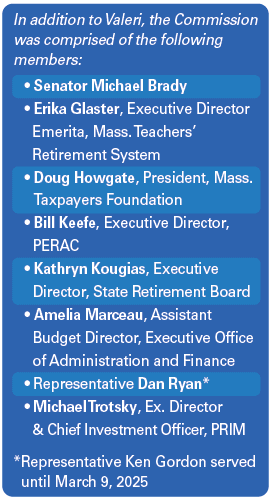 Following more than a year of preparation and work, the Special COLA Commission filed its much-anticipated recommendations and report to the legislature on December 31st.
At the request of our Association, Governor Maura Healey proposed the creation of the Commission within the FY25 State Budget. Once approved by the House and Senate, the 9-member Commission met regularly throughout 2025 to research and develop a series of recommendations to improve the COLA benefit.
The statute creating the Commission outlined three primary objectives: Improve the COLA base for members of the State and Teachers’ Retirement Systems; develop a new Enhanced COLA benefit for long-term retirees who were career public employees; and seek an alternative funding method to pay for improved COLA benefits.
“For Commission members, as well as state policy makers, the question was not whether improved benefits are warranted. The question is how to best address the need to combat inflation, as well as how to pay for the cost of new benefits,” said Association President Frank Valeri, who was appointed to the Commission by Governor Healey. “I believe the Commission achieved its mandate by producing workable well-thought-out recommendations, with the data to back up our findings.
“I want to specifically thank Chairman Bill Keefe, who also serves as Executive Director of PERAC, and his staff for efforts they put into the Commission for more than a year. And specifically, without the work by PERAC Chief Actuary John Boorack and his team, none of this would be possible.”
COLA BASE INCREASE
While stopping short of filing a detailed legislative proposal, the Commission’s recommendations address the three elements to its legislative mandate.
Starting with the traditional COLA base, the report begins by acknowledging the fact the State and Teachers’ COLA base last increased in 2012, when the base was increased by $1,000 to its current level of $13,000. This single increase in the State/Teacher base since 1997 places the maximum annual COLA payment at $390 – an amount that does not come close to meeting the long-term demands of inflation. As the report illustrates, had the State/ Teacher base been indexed to inflation since 1997, it would be nearly $19,000 today.
Of the 104 MA public retirement systems, 87 have a COLA base higher than $13,000. Another 12 systems have a $13,000 base and just one system (Amesbury) remains at the $12,000 base set in 1997.
ENHANCED COLA
Next, the Commission closely examined the impact of inflation on long-term retirees, particularly those who were career public employees and thus heavily rely on their public pension as the primary source of retirement income. Per Massachusetts retirement law, career public employees are identified as those with 20 or more years of creditable service.
The Commission also modeled various eligibility standards based on the amount of one’s retirement allowance, whether it be a percentage of the average salary, retirement benefit, or left uncapped and open ended.
In addition, the Commission evaluated the impact of inflation over the period of retirement and determined that the buying power of a retirement allowance “diminished significantly after 10 years due to inflation and it is then that an Enhanced COLA should be implemented.”
Recognizing the continued erosion of pension buying power as a retiree ages, the Commission recommends that the Enhanced COLA benefit be implemented in tiers. For example, higher benefit levels being applied after 10, 15, and 20 years of retirement.
Mass Retirees also envisions that the new Enhanced COLA benefit would apply to the 102 local retirement systems through the local option process, which requires approval by both the local retirement board and local legislative body. This process is standard for local adoption of any new retirement benefits.
COLA RESERVE FUND
Fulfilling the third element of its mandate (how to pay for new benefits), the Commission has recommended the creation of a COLA Reserve Fund. The fund would then be drawn upon to pay for increases to the COLA base and the new Enhanced COLA benefit.
A portion of excess investment gains would be set aside in the COLA Reserve Fund but continued to be invested alongside all the Commonwealth’s pension fund assets. The Commission recommends that 10% of investment gains above the Commonwealth’s 7% assumed rate of return be dedicated to pay for future COLA improvements.
“Going back to the creation of the COLA benefit in the late 1960s, the challenge has always been how to pay for the benefit. When our public retirement systems went from pay-as-you-go to a funding schedule- based approach in the late 1980s, the question of how to pay for new benefits became harder to answer. The fact that billions in unfunded liabilities had to be paid off made the situation that much more difficult,” explains Mass Retirees CEO Shawn Duhamel. “Unlike Social Security and other federal benefits, public retirement systems must be funded for both current and future retirees. Benefits granted today will, in most cases, also be provided to future retirees. This is why setting aside a small portion of excess investment gains is so important. It provides a dedicated self-sustaining funding source to pay for COLA benefits.”
“With the State and Teachers’ Retirement Systems in excellent fiscal condition and the PRIT Fund continuing to perform extraordinarily well, now is the time for much needed COLA reform. After all, these trust funds were created to solely benefit public retirees. And the money invested in these trusts belongs to retirees and employees. Retirees should share in the success of these systems. It is the right thing to do,” comments Association Treasurer Joe Connarton, who previously served as Executive Director of PERAC.
Our Association has drafted a COLA Reform Initiative based on the Commission’s report and recommendations. Our hope is that the measure will be passed into law this year.
Central to our proposal is the use of excess investment gains to fund both increases in the traditional COLA base and the new Enhanced COLA benefit. Based on the Commission’s recommendation, we have proposed using 15% of the excess gains from 2025 as seed money to establish the Enhanced COLA benefit for State and Teacher Retirees. In subsequent years, 10% of excess gains would be routinely earmarked for the COLA Reserve Fund.
In 2025, the Commonwealth’s PRIT Fund earned a 12.6% investment return – a full 5.6% beyond the system’s 7% annualized assumed rate of return. As we point out in our cover story on page one, the historic long-term success of PRIT continues. Investment returns have exceeded benchmarks in 8 of the past 10 years, with double digit returns having been achieved in 6 of those years.
Next, we have formulated an Enhanced COLA benefit for longterm retirees utilizing the data contained within the Commission’s report. Our plan calls for a new benefit to be paid in addition to the traditional COLA for those career employees who have been retired for 10 or more years, with a pension benefit less than 80% of the average salary for the retirement system. As of 1/1/25, the average salary of a state employee was $84,500 and $85,600 for teachers.
The Enhanced COLA would have three tiers based on years retired: $100 (10); $200 (15); $300 (20). Like the traditional COLA, the Enhanced benefit would become a permanent part of the retirees’ pension to be paid annually.
For the State and Teachers’ COLA base, the Association proposes the base be increased to $16,000. Subsequent increases would occur on a more regular basis, utilizing the COLA Reserve Fund.
“The cost of these proposed benefit improvements is a major consideration. There is no question that COLA improvements are long overdue, but it would be irresponsible for us to propose an unrealistic initiative that is not financially stable and therefore unlikely to be passed into law,” said Legislative Chairman Tom Bonarrigo. “The full cost of the Enhanced COLA is approximately $640 million. A $3,000 increase in the COLA base adds some $1.8 billion in unfunded liability to the system. By using 15% of the 2025 gains, we can fully fund the Enhanced COLA and cover the initial cost of the base increase – while the Commonwealth continues to fully fund its obligations to the retirement systems.
“With the proposed goal of being fully funded in 2039, the state’s pension appropriation for FY27 is $5 billion. Another $3 billion is being spent to fund the GIC. While there are limits to how far benefits can reasonably be increased at once, if our plan is implemented it will put the systems on track to routinely improve COLA benefits going forward. The investment success will finally be shared with all of us.”