


Annual Enrollment is often overshadowed by discussions of premium increases and benefit changes, yet it provides one of the best indicators of the overall health and stability of the Group Insurance Commission (GIC). The choices members make—or do not make—offer valuable insight into member confidence, the effectiveness of the GIC’s health plan offerings, and the overall direction of the program.
At the Commission’s June meeting, which Mass Retirees watched as part of our ongoing monitoring of GIC activities, staff presented the FY27 Annual Enrollment results. While the presentation contained a great deal of data, the overall message was straightforward: the GIC remains a stable program with members expressing continued confidence in their health insurance coverage.
That stability is particularly noteworthy given the current environment. Across Massachusetts, many municipalities continue to evaluate local health insurance changes, including plan design modifications, carrier changes, and transfers into the GIC. In contrast, FY27 Annual Enrollment reflected continuity rather than disruption.
MEMBERS STAYED THE COURSE
Only 3,558 subscribers changed health plans during FY27 Annual Enrollment. Considering the GIC now provides coverage for 460,000 subscribers and dependents, fewer than one percent of covered members elected to move to a different health plan.
Unlike the 2023 health plan procurement— which introduced new plan options and prompted many members to reevaluate their coverage, FY27 featured no significant carrier changes and only limited plan design modifications. As a result, most members found little reason to switch plans.
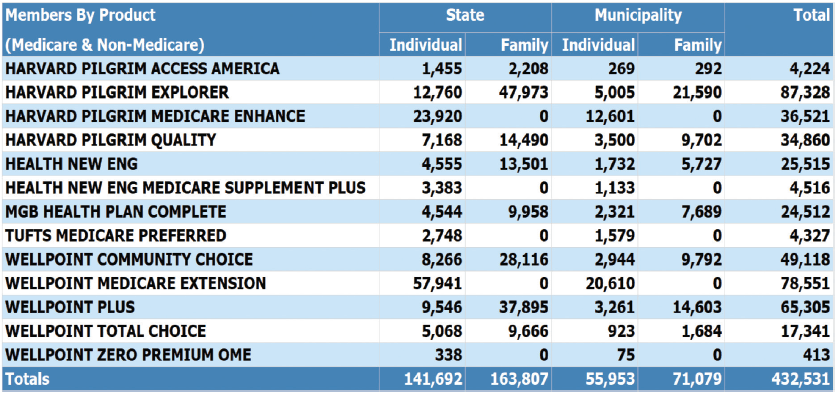
The limited movement is significant because it reflects continuity and confidence in the GIC’s established plan offerings rather than uncertainty or dissatisfaction. The Wellpoint Medicare Extension Plan remained the largest Medicare option with 78,551 enrollees, followed by Harvard Pilgrim Medicare Enhanced with 36,521 members. Harvard Pilgrim Explorer continued as the largest non-Medicare plan with 87,328 members, followed by Wellpoint Plus with 65,305 members.
Four Communities Prepare for GIC Transition
On January 1, 2027, retirees and employees in Belmont, Greenfield, Methuen, and North Attleborough will transition from local health insurance coverage to the Commonwealth’s Group Insurance Commission (GIC). Throughout the evaluation process, Mass Retirees worked alongside local retiree representatives and union leaders to help ensure retirees remained informed and their interests were represented.
As the January 1 implementation date approaches, the Association’s work continues. We will host informational meetings, provide educational resources, and remain available to answer members’ questions and assist retirees throughout the transition.
We also extend our sincere appreciation to the retiree representatives serving on each community’s Public Employee Committee (PEC). Their dedication, countless hours of work, and thoughtful advocacy helped ensure retirees had a voice throughout the process. We thank them for their commitment to representing retirees and look forward to continuing to work together in support of our members.
In response to changes to the national landscape for pharmaceutical benefits managers, combined with a desire to alter the overall procurement calendar, the state’s Group Insurance Commission (GIC) has opted to go to bid a year earlier than its traditional procurement cycle for pharmacy benefits management (PBM).
Now in its fourth contract year, the current PBM managers are CVS Caremark for non-Medicare enrollees and CVS Silverscript for Medicare. Prior to the current contract beginning in 2022, the GIC contracted with CVS for the Medicare PBM and Express Script for non-Medicare.
While the PBM does not alter the retail pharmacy an enrollee chooses to use, it does impact the mail order program and overall management of the prescription drug benefits. More importantly from a cost savings standpoint, the PBM has been traditionally responsible for negotiating prescription drug prices on behalf of the GIC.
Since the current contracts were initiated four years ago, much has changed in the national PBM marketplace and within the prescription drug industry itself. As drug prices have sharply risen and as those costs have played a larger role in overall healthcare spending, so too has government scrutiny over the industry.
The approach taken by large government purchasers of healthcare have also changed in recent years. With more than 470,000 enrollees, the GIC has considerable buying power and market influence.
Additionally, the GIC’s previous procurement calendar had both the PBM contracts and all health plan contracts on the same schedule. As healthcare contracts have become far more complex, it makes sense to move the two different procurements onto different tracks.
For this combination of reasons, the 17-member Commission opted not to renew the current contracts for the optional 5th year, deciding instead to issue an RFP focus on restructuring the plan starting in FY28.
It is far too early to tell what, if any, impact this process may have on retirees and active employees insured under the GIC. As information becomes available, we will be sure to pass it on. As always, please stay tuned!