



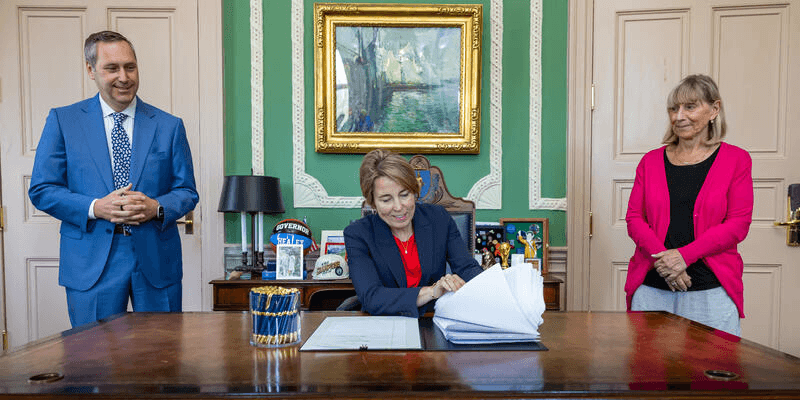
Landmark Change to Benefit Generations of Retirees
The past two years have brought a series of big wins for Massachusetts public retirees.
First was the passage of legislation in 2024 increasing the state’s Basic Life Insurance benefit to $10,000. Next was the passage of the Social Security Fairness Act in 2025, fully repealing the WEP/GPO laws – a life changing occurrence for many retirees. This past winter was the defeat of the state GIC’s plan design changes and cost shifting measurers.
On July 9th, Governor Maura Healey signed COLA Reform into law – a landmark benefit improvement that marks the fourth major victory for our members over the past two years.
Initiated by our Association and nearly ten years in the making, the new COLA Reform law was based on the report and recommendations issued by the Special COLA Commission in December. Mass Retirees drafted legislation based on the Commission’s recommendations, which was then passed by the House of Representatives in April within the state budget.
Due to the timing of this year’s budget process, the Senate was unable to take up the matter when it passed its version of the budget in May.
COLA Reform was then subject to negotiation by the House/ Senate conference committee, which finished its work on June 30th. Thankfully, the measure was included within the conference committee report which was approved by the full House and Senate on July 1st.
“We are very grateful for Governor Healey’s support. A year before announcing her candidacy for governor in 2022, Maura Healey visited our Beacon Street office to learn the details of our efforts to improve the COLA. At our request, she initiated the COLA Commission in 2024. The Governor then appointed me to represent all current and future retirees on the Commission,” said Association President Frank Valeri. “Over the past several months, her staff remained in close communication with our Association as we crafted the COLA Reform Proposal and advocated for it to be passed into law in 2026. Signing the proposal into law was the final act of a process that was years in the making.
“It’s also important to thank State Representative Mark Cusack and Senator Brendan Crighton for their early support of both the COLA Reserve Fund and Enhanced COLA. Both filed bills on our behalf on these initiatives for the past several legislative sessions. In fact, Mark Cusack first filed the COLA Reserve bill in 2017 which is what initiated this whole process.
“While it may take a year or two to grow the COLA Reserve Fund and put these new benefits to work for our members, history will prove 2026 to be a turning point for public retirees.”
Thankful for Support for Public Retirees
Before recapping the specifics of both new laws, it is important that we once again thank those legislators who were directly responsible for the passage of the largest change in the state’s COLA policy since Municipal COLA Reform in 1997 (Chapter 17). Of the 198 sitting members of the House and Senate (there are currently two vacant House seats), there was universal support.
COLA Reform was included by the House leadership within the version of the FY27 Budget reported by the House Ways and Means Committee in mid-April. The direct support of House Speaker Ron Mariano, Majority Leader Mike Moran, Ways and Means Chairman Aaron Michlewitz, as well as Republican Leader Brad Jones, was a significant step toward the proposal becoming law in 2026. Ultimately, the vote in favor of COLA Reform took place as part of the final vote by the House to approve the FY27 State Budget.
Once the bill was in conference committee, negotiations fell primarily upon Chairman Michlewitz, and Senate Ways and Means Chairman Mike Rodrigues – both of whom have a long record of support for public retirees. Because the measure had not been approved by both the House and Senate during the respective budget debates, success in the conference committee process was far from certain.
The largest change in the state’s COLA policy in nearly 30 years is a significant departure from the way the state funds COLA benefits for members of the State and Teachers’ Retirement Systems. Despite the work of the 9-member Special Commission and the universal support from the House, Senate leadership was not 100% sold on the changes.
An ongoing concern, which has historically existed since the modernization of pension funding in the late 1980s, is paying off the remaining unfunded pension liability of the State and Teachers’ Retirement Systems. While the two systems are well on their way toward achieving fully funded status by the current 2039 deadline, significant unfunded liability remains to be paid off over the next 12 years.
As of the last valuation on 1/1/2025, the State Retirement System carried an unfunded liability of $14.1 billion and the Teachers’ System $25.6 billion. However, it is our contention (which was supported by the Special Commission) that the Commonwealth can both incrementally improve COLA benefits while continuing to pay-off its unfunded liability by the 2039 deadline.
“Thankfully, through the work of Chairman Rodrigues, the concerns of the Senate leadership were satisfied, and allowing COLA Reform to survive the conference committee process and be signed into law by Governor Healey. We are grateful that both Chairman Michlewitz and Chairman Rodrigues prioritized doing right by public retirees in this year’s budget,” commented Association CEO Shawn Duhamel.
Major Change in COLA Funding
If you have followed our recent reporting on the history of the COLA here in Massachusetts, you know that funding for the benefit has been a difficult challenge to overcome since the formation of the COLA benefit in the late 1960s. Since the creation of pension funding schedules and the drive to pay-off unfunded liability took hold in the late 1980s, securing funding for new COLA benefits for State and Teacher retirees has remained a major challenge that was nearly impossible to overcome – that is until now.
A key mandate of the Special Commission was to develop a new way to pay for improved COLA benefits – benefits such as the new Enhanced COLA, as well as increases in the traditional COLA base. The Commission’s solution was to create a new COLA Reserve Fund, whereby a portion of excess investment gains would be earmarked to pay for improvements in COLA benefits.
The recommendation, which was included within our proposal as well as within that passed by the House, would have dedicated 10% of excess investment gains to the COLA Reserve Fund. For the Commonwealth’s Pension Reserves Investment Trust (PRIT) Fund, excess investment gains represent returns above the fund’s 7% assumed rate of return.
For example, the PRIT Fund earned 13.13% in 2025 – a full 6.13% above the assumed rate of return. Had 10% of the excess returns been earmarked within the COLA Reserve Fund, it would represent nearly $700 million. Per the Commission’s report, each $1,000 increase in the State/Teacher COLA base costs $600 million. The full cost of the Enhanced COLA benefit is approximately $790 million.
“It is important to point out that while excess investment gains will now be earmarked for COLA benefit increases, monies in the COLA Reserve Fund will continue to be invested by the Pension Reserves Investment Management (PRIM) Board alongside all other pension assets. Nothing changes other than the funds held by the COLA Reserve Fund are to be used for the specific purpose of the COLA,” explains Association Treasurer Joe Connarton, who is a newly elected member of the PRIM Board.
Due to concerns regarding ongoing unfunded liability, the excess return percentage dedicated to the COLA Reserve Fund was reduced to 7.5% as a compromise. Monies will begin to be dedicated to the fund starting in 2026. Through May, the PRIT Fund earned 5.6% year-to-date. Thankfully, the fund has done well despite ongoing economic concerns and is within striking distance of the 7% assumed rate of return with 7 months remaining in the calendar year.
A great benefit of having a dedicated funding source now law is that we will no longer have the question of a COLA funding source serving as an insurmountable hurdle standing in the way of benefit increases.
While the COLA Reserve Fund is now state law for both the State and Teachers’ Retirement Systems, it is local option for the 102 local retirement systems and their governing local bodies.
Enhanced COLA
Long-time members are aware that for nearly a decade we have actively pursued a new COLA benefit for career employees, who have been retired for 10 or more years. Our rationale is simple, the longer you have been retired the harder it is to keep up with inflation. This is particularly true for those who retired prior to the inflationary period sparked by the COVID-19 pandemic.
The creation of an Enhanced COLA benefit is now possible due to the dedicated funding source created by the COLA Reserve Fund. However, the Enhanced Benefit will not take effect right away. The new law requires that sufficient funding be available to pay for the benefit in full before it takes effect. As we mentioned above, the total cost of the Enhanced COLA for the State and Teachers’ Retirement systems is just shy of $800 million.
Should the PRIT Fund produce an excess investment return in 2026 that would pay for the Enhanced COLA in its entirety, the new benefit would begin for FY28. Otherwise, the Reserve Fund would continue to grow until sufficient funds are available.
To be eligible for the Enhanced COLA retirees must meet a defined criterion: Have at least 20 years of creditable service, been retired for a minimum of 10 years, and receive a pension benefit that is less than 80% of the current active employee salary for the retirement system. The respective salaries for both the State and Teachers’ Retirement Systems are roughly $85,000 – meaning that an eligible retiree must be receiving a pension of less than $68,000.
At the local level the average salary is set accordingly across each of the 102 local retirement systems.
Disability retirees are covered regardless of years of creditable service. Surviving spouses are eligible, if the retiree would have been eligible.
Since the state cannot mandate new costs on municipal government, the Enhanced COLA is also a local option. However, we have already heard from several local retirement systems who appear eager to adopt the new benefit law. As we did following the passage of Chapter 17, the municipal COLA Reform law passed in 1997, we will work closely with local retirement boards and municipal officials to help with advocating for local acceptance.
COLA Base
As you read in the July Voice, the average COLA base across the 102 local systems is now above $17,000. Due to the more manageable cost of the benefit, combined with higher pension funding ratios in some communities, many local retirement systems have been able to incrementally increase the local COLA base to correspond with the investment success of each respective system.
At the state level, where unfunded liabilities run into the tens of billions of dollars and the cost of each $1,000 increase is $600 million for the State and Teachers’ Systems combined, funding base increases has been a difficult nut to crack – that is until now.
The reason for the high cost of each COLA base increase is that pension funding rules assume that a 3% COLA will be paid each year. Under state law each COLA increase becomes a permanent part of a retiree’s base pension – meaning that the same COLA paid in 2026 will be paid in 2027 and in perpetuity over the life of the retiree (as well as survivor). Not only will the benefit be paid to today’s retirees, but all future retirees.
Under the new COLA Reform law, once the Enhanced COLA is fully funded, monies earmarked within the State and Teachers’ Retirement Systems COLA Reserve Fund will be dedicated to fund incremental increases to the State and Teachers’ COLA base. This will take place automatically as the money is available to cover the $600 million cost for each $1,000 increase – without the need for further legislative approval.
The legislature will continue to authorize the annual payment of the 3% COLA for State and Teacher retirees, but it will no longer play a direct role in increasing the COLA base. This is a dramatic departure from past practice and one that has come about due to significant progress that has been made in paying off the Commonwealth’s unfunded pension liability.
While we would have very much liked to have seen the current State/Teacher COLA base increased to $16,000 starting with FY27, the upfront cost to do so would have been $1.8 billion. This cost would have been added to the $5.1 billion appropriated by the state to fund its share of State and Teacher pension costs for the coming fiscal year.
That said, the Association is grateful that for the 28th consecutive year, the state has granted a 3% COLA for all retired State employees and Teachers who are members of the Teachers’ Retirement System. In 2022, the state approved a one -time 5% COLA to help retirees combat the severe inflation that took hold during the pandemic.